If you run a Shopify brand in India, the AI shopping shift is not really about “ranking in ChatGPT.”
That is the surface-level take.
The real shift is that your store is now being read like a system, not just like a website.
Google launched the Universal Commerce Protocol, said it will power checkout on eligible Google product listings in AI Mode and Gemini, and added new Merchant Centre attributes for conversational shopping like common product questions, compatible accessories, and substitutes.
Shopify moved at the same time. Its 2026 product releases say merchants can sell inside ChatGPT, Copilot, Google AI Mode, and Gemini through Agentic Storefronts, while Shopify Catalog now acts as a shared product layer for AI channels.
This is why the old GEO frame is too small.
The real issue now is not “can AI mention my brand?”
It is “Can AI systems read our store well enough to recommend us, quote us right, and complete a purchase without making us look stupid?
That is the real test in 2026.
Most ecommerce teams still think AI shopping readiness means “write better content for LLMs.” That is lazy thinking. In practice, the brands that will win are the ones whose product facts, policy rules, and inventory state can be read cleanly by machines.
That is the part most brands are missing. Your storefront may look polished to a person and still be unreadable to an AI agent.
What AI shopping actually needs from your store
There are three layers that now matter more than most brand teams think:
Layer | What it means? | What breaks if it is weak |
Product data | Can AI tell what the product is, who it is for, and what makes one option different from another? | Wrong product picks, weak matching, bad answers |
Policy data | Can AI tell the buyer what happens if they need a return, refund, exchange, or support? | Wrong promises, angry buyers, support load |
Stock + fulfilment data | Can AI say “in stock” and “delivery in X days” and still be right? | Trust loss, order issues, channel drop-off |
The 2026 AI shopping test
Ask these five questions.
1) Can an AI understand what the product actually is?
Shopify’s own 2026 guidance is direct: titles, descriptions, variant options, images, prices, and product taxonomy must be complete and written in literal language, because these are the fields AI agents rely on.
Check now
Product titles say what the item is, not just a brand copy
Material, size, fit, skin type, use case, care, and compatibility sit in fields.Color and size sit as variants
Key product facts are not trapped inside images
Bad sign
Your PDP sounds smart but does not answer basic buyer questions in simple words
What good looks like
“Women’s cotton kurta, straight fit, blue, machine wash” is good
“Summer ease in indigo calm” is useless to AI
2) Can an AI read your policy without making wrong promises?
This is where many Indian D2C brands are sloppy.
Google Merchant Center now lets brands set return policies for all products, groups of products, or single products through return_policy_label. It also lets you define return method, restocking fee, and refund time. That means return logic is now part of machine-readable commerce data, not just legal text on a page.
Check now
Return window is clear
Replacement-only items are marked clearly
Hygiene, final-sale, made-to-order, and clearance items have separate rules
Refund time is stated in a way a machine can read
Product-level policy exceptions exist where needed
Indian brand example
Minimalist’s live policy is clear: wrong, damaged, or expired product cases must be raised within seven days of delivery. That is clear enough for both shoppers and machines.
Bad sign
One giant “Returns & Refunds” page that hides all exceptions in long legal copy
3) Is your stock truth actually true?
This is where the pain starts in India.
Shopify Catalog can surface current pricing, live inventory, and accurate discounts to AI channels, and catalog data is structured for AI agents to parse. But if your internal stock truth is wrong, that clean feed still points to bad reality.
Check now
Inventory in Shopify matches warehouse reality
Out-of-stock items do not stay live in ads, feeds, and AI surfaces
Discounts in channel feeds match on-site pricing
Low-stock or fast-moving SKUs sync fast enough for real demand spikes
Bad sign
AI says “in stock”, site says “out of stock”. That kills trust fast.
4) Does your delivery promise match Indian pin-code reality?
This is not a side issue. It is core.
Google Merchant Center supports shipping cost by region and by postal code in India. So location logic is part of structured commerce setup now.
For Indian brands, this matters more than in many other markets because serviceability, COD rules, and delivery speed are not flat across the country.
Check now
Pin-code logic is real, not just marketing copy
COD fees and limits are clear
Non-serviceable areas are handled before checkout, not after payment
Delivery windows are honest by region
Indian brand example
Minimalist states that it ships to 20,000+ pin codes across India and gives a clear shipping range. That is useful because it sets a real service frame.
Bad sign
“Pan-India shipping” on the home page, but ops later cancels prepaid orders due to serviceability.
5) Are you set up for direct AI commerce, not just AI mentions?
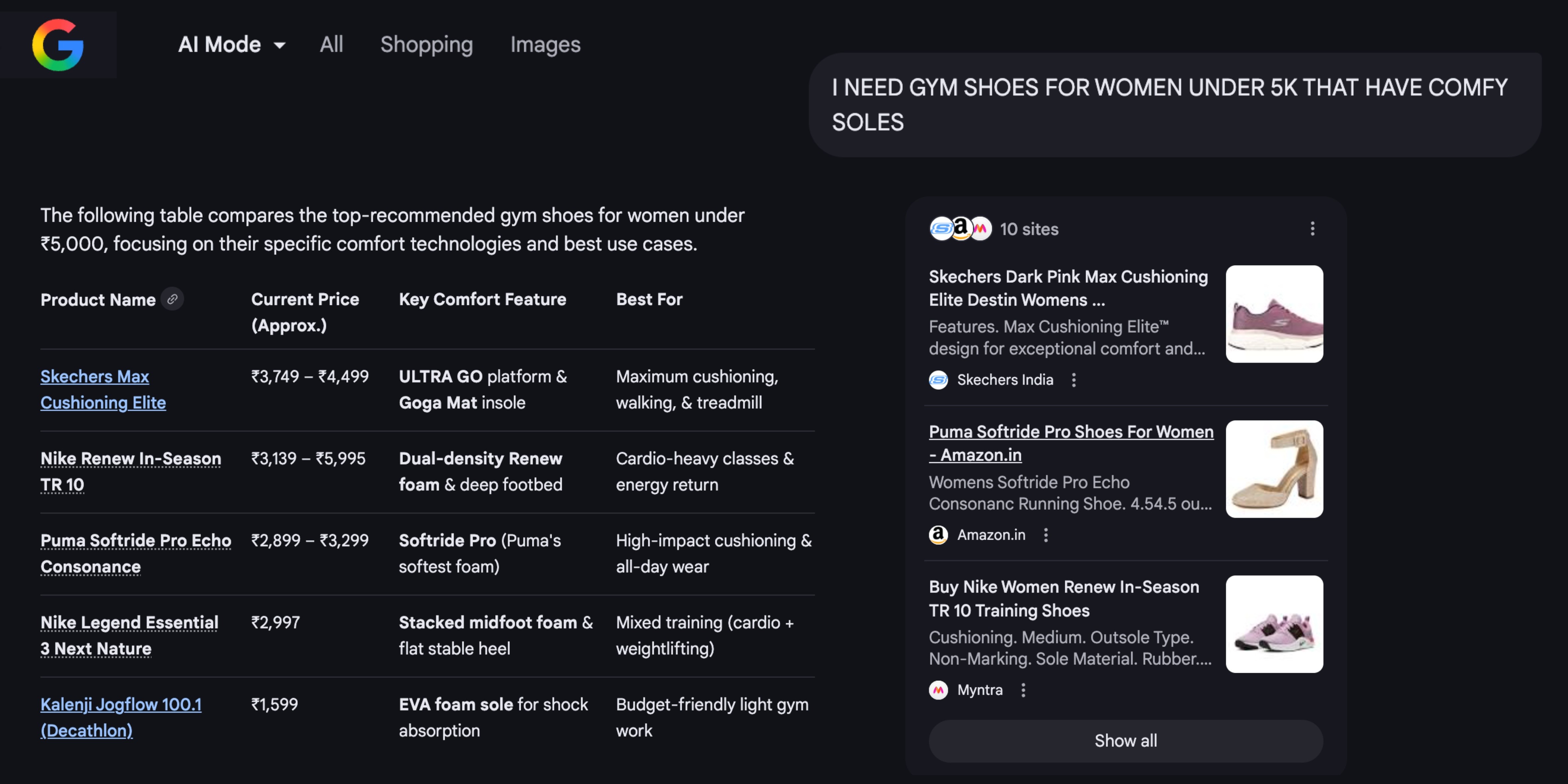
Stores can sell directly inside ChatGPT, Google AI Mode, Gemini, and Copilot through agentic storefronts, and that these are active by default when available. Orders still sit inside Shopify with channel attribution.
Google says UCP is meant to power agent-led buying across surfaces, and it plans to expand globally after the first rollout.
Check now
Your Shopify setup for agentic storefronts is reviewed
Catalog mapping is clean for custom product data
Product grouping makes sense
Titles, images, and key attributes are not weak or missing
Your team knows which channels can show direct checkout vs redirect
Bad sign
You are “doing GEO” with blog posts, but no one has checked Shopify Catalog mapping
What to fix first
Do not start with the full catalog. That is how teams waste a month and ship nothing.
Start here:
Week 1
Pull top 100 SKUs by revenue
Flag split variants
Flag vague titles
Flag missing buying fields
Week 2
Rewrite titles
Fix variant grouping
Fill material / fit / ingredient / care / compatibility fields
Add answer blocks by product family
Week 3
Rewrite policy by product type
Check footer vs PDP vs checkout vs Merchant Center
Add refund timing clearly
Week 4
Check stock match across PDP, Catalog, and Merchant Center
Check sync lag on top movers
Check shipping logic by top postcodes
Review AI channel settings and product visibility
Let’s be honest about something.
Nobody can tell you exactly how to rank #1 in ChatGPT or any other AI chatbot. Not even the companies building them.
Why?
Because these systems keep changing. Fast.
The models change. The retrieval layer changes. The product layer changes. The way results are shown changes. And most of it is not explained in a neat public playbook.
So anyone selling you a fixed formula for “ranking in ChatGPT” is either guessing, oversimplifying, or trying to sell you confidence they do not actually have.
What you can do is get your store into the shape these systems are most likely to trust:
clear product data, clear policy data, and stock data that actually matches reality.
That is a much smarter way to think about AI shopping readiness in 2026.