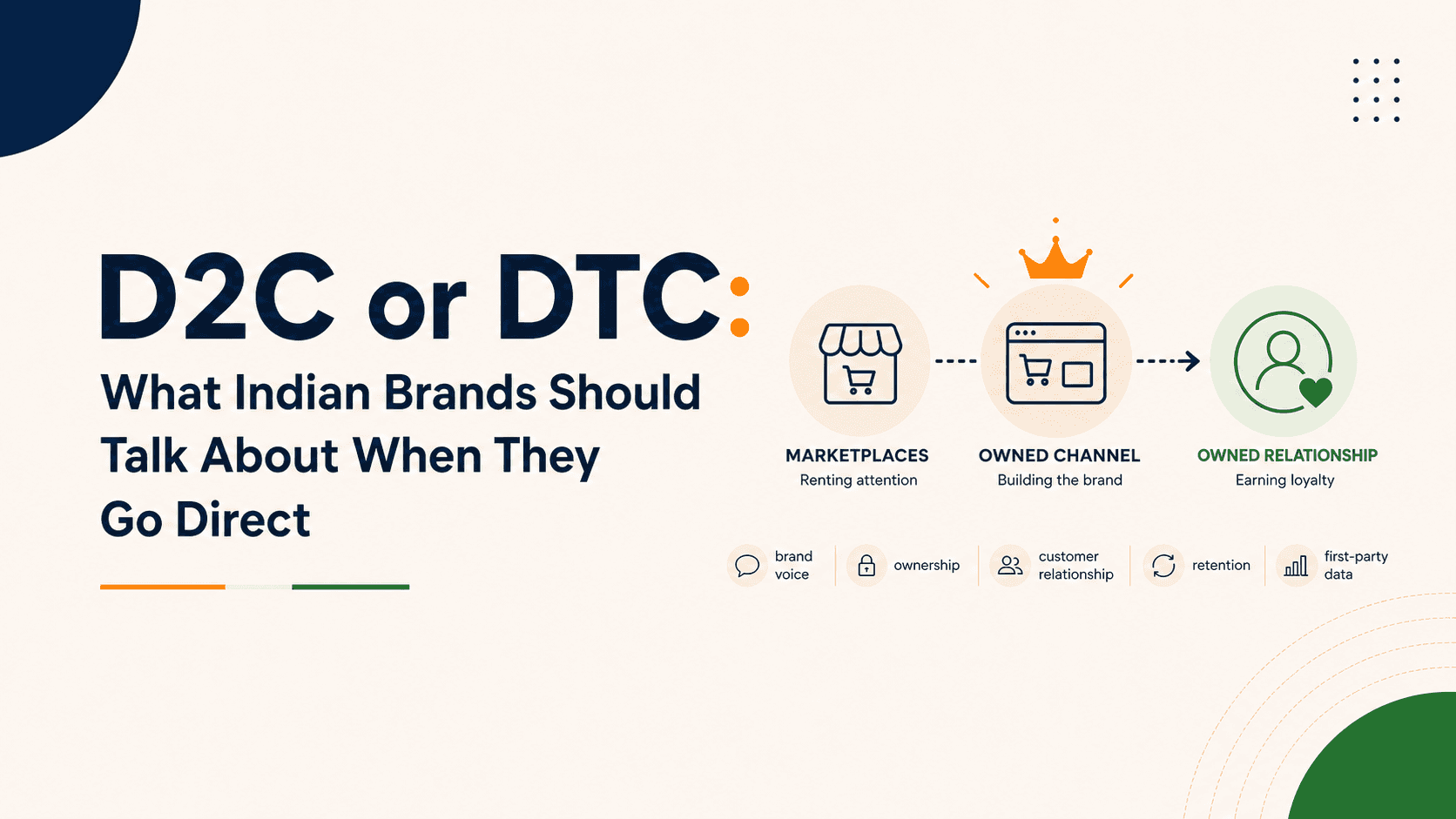
The terms D2C (Direct-2-Consumer) and DTC (Direct-to-Consumer) are often used interchangeably to describe brands that sell straight to end-customers. In practice, both mean bypassing traditional retailers and wholesalers, so the brand owns the entire customer journey.
In short, there is no meaningful difference in definition – D2C and DTC both refer to the same business model. Customers click to purchase without intermediaries, giving the brand control over pricing, messaging and data.
That said, context can vary.
For example, a recent industry memo observes that DTC has also become popular in media (streaming) and advertising, where “media and advertising sectors are stealing the search traffic for DTC news”. DTC is semantically noisier because in India it can also collide with searches for Delhi Transport Corporation. For product brands, however, D2C/DTC remains about owning your sales channel.
The practical recommendation is therefore simple. Use D2C as the primary external term on Indian websites, metadata, thought leadership, and newsletters. Use DTC only as a secondary synonym for global discoverability or when you are explicitly discussing a global playbook.
Why It Matters for Indian Brands
India is in the midst of a D2C boom. With low barriers to online selling, many Indian entrepreneurs have leapt straight to consumers. The government’s startup drives and pandemic-driven shopping have accelerated this trend.
A recent Invest India report notes Shark Tank India mostly featured D2C founders (e.g. Sugar Cosmetics, Mamaearth, Lenskart), reflecting that D2C is “the most popular business segment currently in India”. Digitisation is helping local entrepreneurs bypass India’s notorious middlemen – D2C “bridged the gap between opportunity and success for Indian entrepreneurs”
Google India found that search interest in D2C brands jumped 533% as businesses moved online during the pandemic. Queries like “which brand is good” grew 41%, and searching for a “brand’s official store” grew 80%.
In other words, Indian consumers are actively researching and buying from brands’ own sites. Indian D2C brands have scaled fast – homegrown D2C startups like Mamaearth , Wakefit , MyGlamm | Good Glamm Group and Licious became unicorns (valued over $1B). Many more have raised capital: since 2020 over 140+ Indian D2C brands have together raised ~$500M in VC funding.
This growth outlook is dramatic. The Indian Brand Equity Foundation projects India’s D2C market to hit ~$60 billion by 2027 (about 40% CAGR). For context, India’s e-commerce itself is already a multi-billion market, and D2C is powering a big chunk of its expansion. Analysts predict digital channels will account for the majority of sales soon – one report cites ~54% of revenue shifting online in the next few years. Clearly, Indian brands that master direct channels can reap outsized rewards.
Indian shoppers increasingly research and buy directly from brands. According to Google India, pandemic-era searches for D2C brands surged 533% and queries for “official brand stores” jumped 80% as consumers sought out direct purchases.
Key Implications for Indian Brands
The D2C/DTC model has several critical impacts on an Indian brand’s business:
Operations & Logistics: Going D2C means owning the supply chain. Instead of shipping pallets to distributors, brands must deliver single units to customers nationwide. In practice, Indian D2C players often build their own warehousing, inventory systems and last-mile logistics (e.g. Lenskart’s stores and delivery network, boAt’s warehouses). They may start pure D2C online, but many expand to “clicks-to-bricks” – opening physical pop-ups or stores once brand awareness grows (just as global D2C pioneers like Warby Parker and Casper eventually did). Logistics complexity also means handling returns, customer support and omni-channel integration, tasks traditionally borne by retailers.
Customer Data & Marketing: A top D2C benefit is direct access to first-party data. When you sell direct, you collect customers’ emails, purchase history and preferences yourself. This enables hyper-personalization, loyalty programs and smarter marketing (AI-driven recommendations, tailored ads). Indian brands can use these insights to cross-sell, upsell and continuously refine products. However, building a customer base requires heavy digital marketing and community-building (social media, influencers, content marketing). Early-stage D2C brands often rely on aggressive social ads and influencer campaigns to acquire users, but this comes at a cost: rising advertising spend and declining ROI.
Brand Positioning: Indian consumers are becoming savvy. They recognize the value of buying authentic from brands – search interest in “official brand store” shows many avoid unauthorized channels. A D2C approach lets brands emphasize quality, service and story directly. For example, customers have come to expect perks like free shipping, easy returns or customization from D2C brands. Brands can also weave in social causes or sustainability (e.g. packaging promises) to resonate with millennials. However, they must maintain consistency: a disjointed D2C experience (e.g. frequent stockouts or login issues) can quickly erode trust.
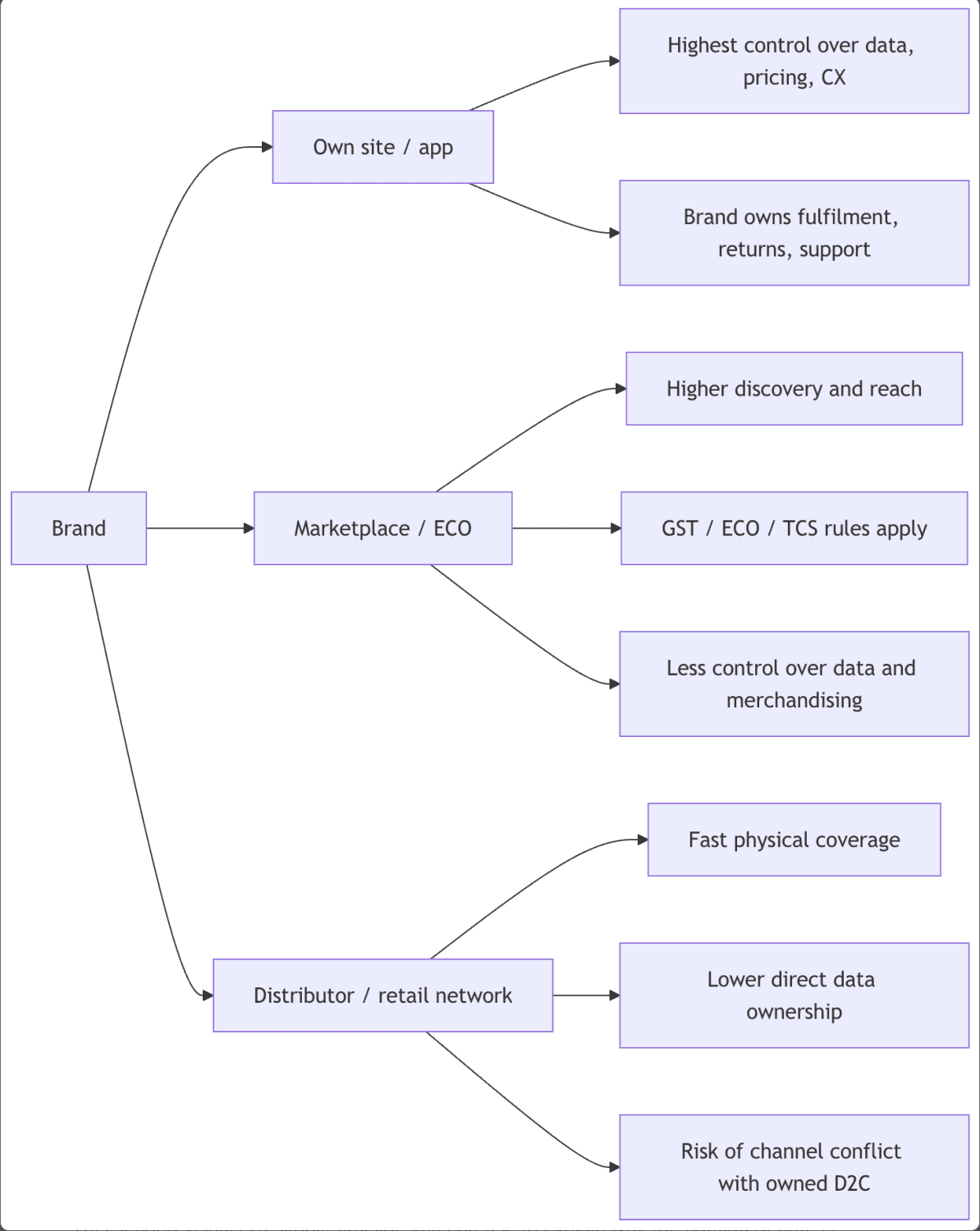
This below diagram shows the real decision tree of owned channel versus marketplace versus distributor-led execution.
Actionable Takeaways
Clarify your strategy: Use “Direct-2-Consumer” language consistently. In content and PR, mention both D2C and DTC if unsure, but emphasize your own-channel focus. Highlight the benefits (higher margins, data ownership) and be transparent about logistics (e.g. fast shipping, easy returns).
Build omni-channel resilience: Even if you start online, plan for hybrid approaches. Data from Salesforce suggests 54% of brand revenue will come from digital channels soon. But long-term winners often complement e‑commerce with select retail (own stores, pop-ups). Monitor your inventory and fulfillment closely – D2C means delivering single orders nationwide.
Focus on customer data wisely: Leverage the first-party data to personalize marketing and products. Yet ensure full compliance: review India’s DPDP Act requirements now and prepare your privacy policies and systems. Think of data as an asset (for targeting and product design) but also as a liability if mishandled.
Balance marketing and credibility: Aggressive digital marketing helped many D2C brands grow, but ASCI's reports warn against over-hyped claims. Keep 80/20 ratio: about 80% of your content/ads should educate or engage, 20% promotional. Use storytelling and social proof (influencers) to build trust. Always be ready to substantiate any health or quality claims with data to avoid ASCI disputes.
Optimize SEO and content for both terms: Audit your website and blog to include both “D2C” and “DTC” where relevant. Use synonyms: e.g. “direct-to-consumer brand”, “sell directly online”, etc. This captures all searchers. Also optimize for related queries like “official store” or product keywords, since Indians increasingly search before they shop.
Plan for growth: Keep an eye on market trends – India’s D2C space is evolving (Tier-2 cities are a new focus, as recent reports note). Stay nimble with product launches, test via online feedback, and be ready to adapt. Many experts suggest the winning formula is “D2C-first, then selective retail” – launch direct to own data and margins, then expand reach.
Indian brand case studies
Honasa Consumer and Mamaearth
Honasa is the largest digital-first BPC company in India, a digital-first house of brands, and an omni-channel business present across 750+ districts. Its own brand history says the business used a community of digitally active mothers to understand needs and shape product innovation. This is a classic Indian D2C origin story: start with a direct consumer problem, use digital listening to refine product-market fit, then scale beyond a purely online model. The lesson is that D2C in India is often most powerful as a consumer-intelligence system before it becomes a mass-distribution system.
Wakefit
Wakefit is a D2C sleep and home solutions provider, and its Great Indian Sleep Scorecard page says the company has sold over 18 lakh products to more than 8 lakh customers across 19,000+ pin codes, explicitly adding that “as a D2C brand” it remains in constant touch with customer needs. Public IPO research also positioned it as one of India’s leading D2C home-and-furnishings businesses. The lesson is that D2C can work even in bulky categories, but only when the brand builds logistics discipline, product standardisation, and strong post-purchase trust.
Lenskart
Lenskart explicitly calls itself an omnichannel direct-to-consumer retail brand, and its internal writing says that physical stores are an integral part of the vision. It also documents how returns, repairs, and exchanges are unified across app, stores, and customer support. This is the clearest Indian proof that successful D2C does not have to remain online-only. The lesson is that once a category involves fit, trial, service, or repair, the most durable model is often owned relationship plus omnichannel service, not pure website-only selling.
Amul
A very unique model distributing ambient, chilled, frozen, and fresh products through four distribution highways, supported by branch expansion, super-distributors, sub-distributors, and a large exclusive-store network. Amul now also runs an online shop, but the company’s official disclosures make clear that its historic strength is route-to-market design rather than a pure direct-commerce stack. The lesson is that in high-frequency cold-chain categories, a dense channel network can be more strategically important than the “D2C” label.
What does this mean for your brand? Are you leveraging the full advantage of D2C/DTC, or could you strengthen your strategy?
Share your thoughts or questions below – let’s discuss how Indian brands can thrive by going direct.